



ESSAY CURE’s Christine Gacharná sits down with Todd O. Pettibon, Partner at Toth Financial, to discuss the Return on Investment (ROI) of a college degree that students should consider.
If you’re 18 years old, someone is about to ask you to make a $100,000 decision.
And most people will tell you to make it in about five minutes.
The decision is college.
For decades, the advice has been simple:
“Go to college.”
But that advice leaves out an important detail.
College is not just an educational decision.
It’s one of the largest financial investments most families will make, behind saving for retirement and buying a home.
I sat down with a portfolio manager to talk about this exact issue with high school students. What started as a conversation about college quickly turned into something much bigger:
How money actually grows over time — and why the decisions students make in their early twenties matter more than they may think.
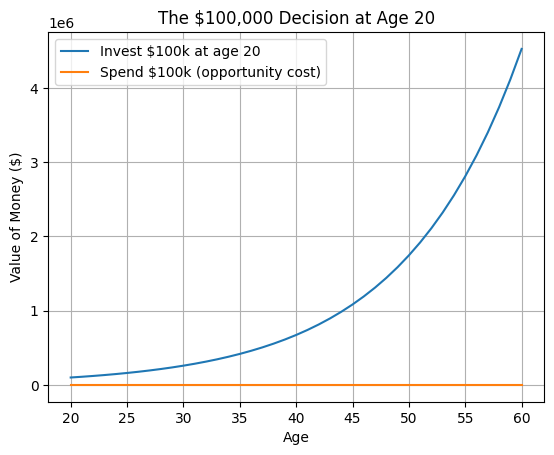
The $100,000 Decision
If $100,000 is invested at age 20 and earns an average 10% annual return, it could grow to more than $4 million by age 60. This illustrates the opportunity cost of large financial decisions early in life.
This doesn’t mean students shouldn’t go to college. It means they should think carefully about how much they spend to do it. Reducing the cost of college by even $20,000–$40,000 can dramatically change long-term financial outcomes.
The Hidden Price Tag of a Bachelor’s Degree
Let’s start with the numbers.
The average in-state tuition for a four-year degree is about:
$45,000 for tuition, books, and fees.
Add room and board, and the real cost climbs closer to:
$80,000–$100,000.
That’s a staggering amount of money for someone just beginning adulthood.
And like any investment, it raises a simple question:
What do you get in return?
On average, the answer is: quite a lot.
According to Social Security data, people with a bachelor’s degree earn significantly more over their lifetime than those with only a high school diploma.
Rough estimates suggest:
Men with a bachelor’s degree earn about $900,000 more over their lifetime
Women earn about $630,000 more
Graduate degrees increase that gap even further.
But there’s a catch.
You only get the return if you actually graduate.
Many students take on tens of thousands of dollars in loans —
and never finish their degree.
Which means they carry the debt without receiving the benefit.
The Financial Concept Every Student Should Know
During our conversation, Mr. Pettibon explained something called the Rule of 72.
It’s one of the simplest ways to understand how investing works.
The rule is straightforward:
72 ÷ your rate of return = how many years it takes your money to double.
If your investments grow at 10% per year, your money doubles roughly every 7.2 years.
That means if you invested $86,000 at age 20, here’s what could happen:
Age 20 → $86,000
Age 27 → $172,000
Age 34 → $344,000
Age 41 → $688,000
And that’s without adding a single additional dollar.
That’s the power of compound interest.
Your money starts making money —
and then that money starts making money, too.
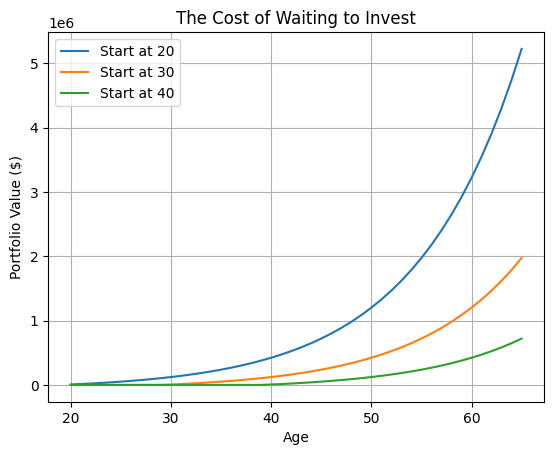
What the chart demonstrates
By age 65:
Start at 20 → ~$5.2 million
Start at 30 → ~$2.0 million
Start at 40 → ~$740,000
Even though the monthly investment is the same, the person who starts at 20 ends up with more than double the wealth of someone who starts at 30.
This is the time value of money + compounding.
The Most Important Financial Advantage Young People Have
Young people often assume their biggest financial advantage will be:
getting a high salary
choosing the right career
working harder than everyone else
But none of those are actually the biggest advantage.
The real advantage is time.
Time is what allows compound interest to work its magic.
And the difference between starting early and starting late can be enormous.
Imagine three people who all invest the same amount every month.
The only difference is when they start.
Someone who begins investing at 20 can end up with millions more dollars than someone who begins at 30 or 40.
Not because they invested more money.
Because they gave their investments more time to grow.
There’s More Than One Path to Success
One of the most surprising statistics from our conversation:
Only about 27% of college graduates work in jobs directly related to their major.
Think about that.
Most people spend four years studying something —
and then build careers doing something else entirely.
That doesn’t mean college is a mistake.
But it does mean something important:
There are many ways to build a successful life.
Some people thrive through:
college degrees
trade careers
technical training
entrepreneurship
apprenticeships
The key isn’t the path.
The key is what you do with the income you earn along the way.
The Financial Habit That Actually Builds Wealth
After working with hundreds of clients and nearly a billion dollars in investments, Mr. Pettibon shared something interesting.
The people who build wealth usually have one thing in common.
They’re not necessarily the highest earners.
They’re consistent savers.
They live within their means.
They save part of every paycheck.
And they let time do the heavy lifting.
A common rule of thumb is to invest about 15 percent of your income.
Do that consistently, and something powerful begins to happen.
Your money starts working for you. [Compare that to the idea of you working for your money — hmmmm.]
Eventually, the income from your investments begins to support your lifestyle.
That’s when you reach what everyone ultimately wants:
financial independence.
The Real Lesson
Don’t get me wrong; the purpose of this conversation isn’t to argue against college.
College is an incredible opportunity, and we here at College App Help Desk and ESSAY CURE not only went to college but also enjoy helping students to find a similar fulfilling college path.
The real lesson for our students is this:
Think about the financial consequences of your decision to purchase an education.
Ask questions like:
What will this degree cost?
What career opportunities will it open?
Are there ways to reduce the cost?
Because when you’re young, the most valuable asset you have isn’t money.
It’s time.
How you use that time can shape your financial life for decades.
Thank you, Mr. Pettibon, for sharing your time and talents with our students.
https://thecollegeinvestor.com/7868/college-worth-investment/
https://educationdata.org/average-cost-of-college
Follow-Up for Students Who Want to Build Financial Health
1. Toth Financial
A boutique wealth management and investment advisory firm headquartered in Leesburg, Virginia, that manages about $1 billion for primarily high-net-worth clients using long-term portfolio strategies. Toth Financial is an independent investment advisory firm that provides wealth management and portfolio management services to individuals, families, and institutions.
Unlike brokers who earn commissions on products, RIAs like Toth Financial typically operate under a fiduciary standard, meaning they are required to act in their clients’ best interests.
“Time is the biggest financial asset you have when you’re young.” — Todd Pettibon
2. The Psychology of Money — Morgan Housel
One of the most widely recommended finance reads for beginners.
What students learn:
Why behavior matters more than intelligence in money decisions
Why saving is more powerful than chasing high returns
Why time is the biggest wealth-building tool
Great takeaway quote:
“Wealth is what you don’t see.”
This article/book teaches students that financial success is mostly about habits.
3. The Simple Path to Wealth — JL Collins
Originally written as letters from a father to his daughter explaining money.
What students learn:
How investing in index funds works
Why avoiding debt matters
Why simplicity often beats complexity in investing
Students often appreciate how clear and practical it is.
4. Mr. Money Mustache — The Shockingly Simple Math of Early Retirement
This is one of the most famous personal finance articles online.
Key lesson:
The percentage of your income you save determines how quickly you can become financially independent.
It clearly demonstrates:
Why saving rate matters more than income
How lifestyle choices impact long-term freedom
Students often find this eye-opening.
5. The Rule of 72 Explained (Investopedia)
A simple explanation of the concepts discussed in this article.
Students can learn:
How compound growth works
Why starting early matters
How long investments take to double
Investopedia is a great beginner finance dictionary for students.
6. Consumer Financial Protection Bureau: Student Loan Basics
Very practical resource for students considering college.
Topics covered:
Understanding student loans
Interest rates
Repayment options
Avoiding excessive debt
This is particularly useful for students who are trying to understand what borrowing actually means.
7. JL Collins — Why You Should Avoid Debt
Students often assume debt is unavoidable.
This article explains:
Why consumer debt slows wealth building
Why avoiding debt early changes your financial trajectory
How small financial habits compound over time
Terms Students Should Learn:
Five financial concepts worth learning early:
Compound interest
Index fund investing
Student loan interest
Saving rate vs. income
The time value of money
Understanding just these five ideas puts a student far ahead of many adults financially.
Thank you for reading!
If you’re a student reading this, the most important thing you can do is start learning about money early.
You don’t need to become a finance expert. But understanding a few key ideas — saving, investing, compound interest, and debt — can change your financial life in ways that compound for decades.
