


If you sit down at your computer, open a blank document, and immediately try to write a polished “rough draft” of your Common App essay, you are setting yourself up for a massive waste of time.
That is a rigid mental model—a deeply ingrained habit of how you think writing should work. To write an essay that actually gets you accepted into your reach schools, you have to change your muscle memory around writing. As Albert Einstein once noted, breaking a mental model is harder than splitting an atom.
To write a compelling college application essay, you need to understand how to leverage your blind spots and rewire your writing process.
1. The Three Adjectives That Open Doors
When college admissions officers read your application—and when your high school teachers write your letters of recommendation—they aren’t looking for a flawless, perfect superhero. They are looking for three specific traits:
Curious
Humble
Teachable
College is designed to safely challenge your worldview. To prove you’re ready for that, you have to be willing to look at situations where you weren’t perfect, where you tripped up, and where you had to recalibrate.
2. Uncovering Your Essay Topic via the “Johari Window”
Where do the best essay topics come from? Oftentimes, they come from blind spots.
Legendary investor Charlie Munger talked about building a multidisciplinary "latticework" of mental models to understand the world. One of the core models we use is the Johari Window paired with your DISC personality profile to identify where your self-perception clashes with reality.
A blind spot is something others see about you, but you don’t see about yourself. It’s that jarring moment of sudden, uncomfortable introspection.
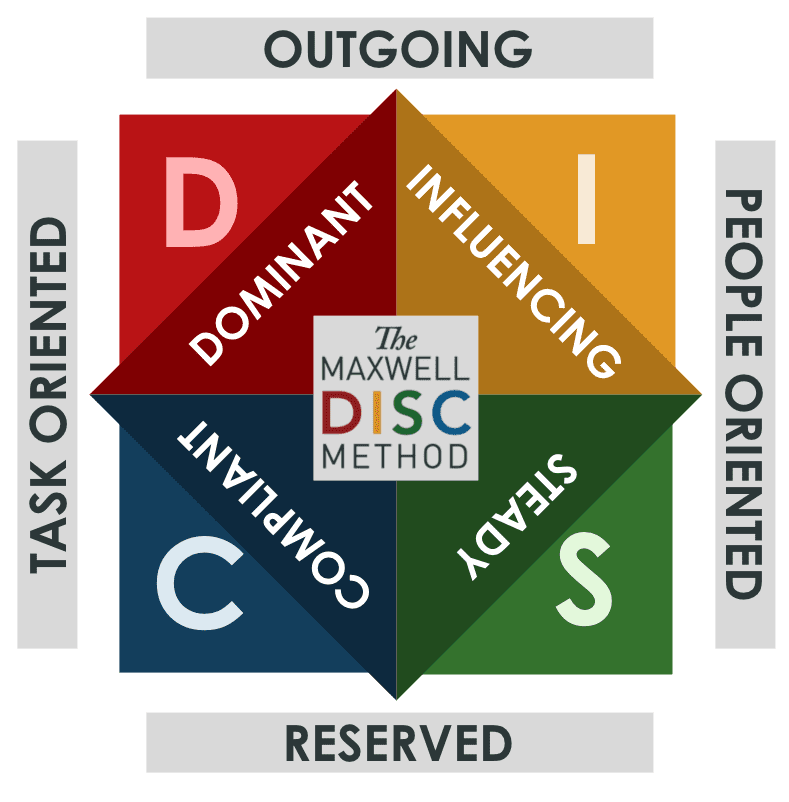
Depending on your DISC letter, your best essay topic might be hiding right in your personal growth areas:
If you are a “C” (Compliant): Did your obsession with perfectionism cause your pace to slow down so much that you missed a deadline or an opportunity? How did you learn to pivot toward excellence instead of impossible perfection?
If you are an “S” (Steady): When did you struggle to accept change, or fail to balance the needs of others with your own? How did you learn to show initiative?
If you are an “I” (Influencing): Was there a time you talked too much, didn’t listen, and missed something incredibly important? What did that teach you about real communication?
If you are a “D” (Dominant): Was there a time when you lost control of a situation? Were you unfairly taken advantage of? What did you learn about managing conflict and/or understanding and respecting the boundaries of others?
The Laundry Room Realization
Challenging a mental model can be huge, or it can start small. I remember being in my college dorm basement doing laundry. A friend was doing hers completely differently from how my mom taught me. At first, I thought she was doing it all “wrong,” but then I realized two important things: (1) she was going to be finished folding clothes much faster than I would be and (2) I’m in college. My mom isn’t here. My Mom is probably not going to care if I change the way I fold my clothes.
Does my old mental model still serve me?
College application essays are less of a sales pitch and more of a job interview. the goal is to tell the interviewer (in this case, the AO) about a sliver of time in your life that highlights a bigger picture of who you are. Showcase your self-awareness. A story about discovering and fixing a blind spot is essay gold.
3. The Elite Soldiers Model: Write for the Reader
Why do we stress daily 15-minute freewriting exercises instead of jumping straight into “writing a rough draft?” Because of the Elite Soldiers Model:
“In the thick of battle, you will not rise to the level of your expectations; you will fall to the level of your training.”
When college application stress peaks, you will fall back on your training. If your training is just staring at a blank page, hoping for perfection, you will freeze.
Furthermore, you need to understand the mechanics of your medium. Linguist Noam Chomsky noted that language carries infinitely varying meanings. Writing is unique because you are communicating using symbols on a page. Your unknown admissions reader has to look at those symbols and interpret them through their own filters and biases.
To get your essay passed from reader to reader all the way to the final decision-makers, you have to focus on clear, resonant content — not a hyper-polished, albeit empty narrative.
4. The 80/20 Rule of Writing: Ditch the Spellcheck (For Now)
Use the Pareto Principle. If you focus your writing in the areas where you are likely to get the biggest benefit of result, guess what? You’ll get better results.
Instead of spending 80% of your energy obsessing over grammar, spelling, and punctuation writing a rough draft, spend that time in these three steps:
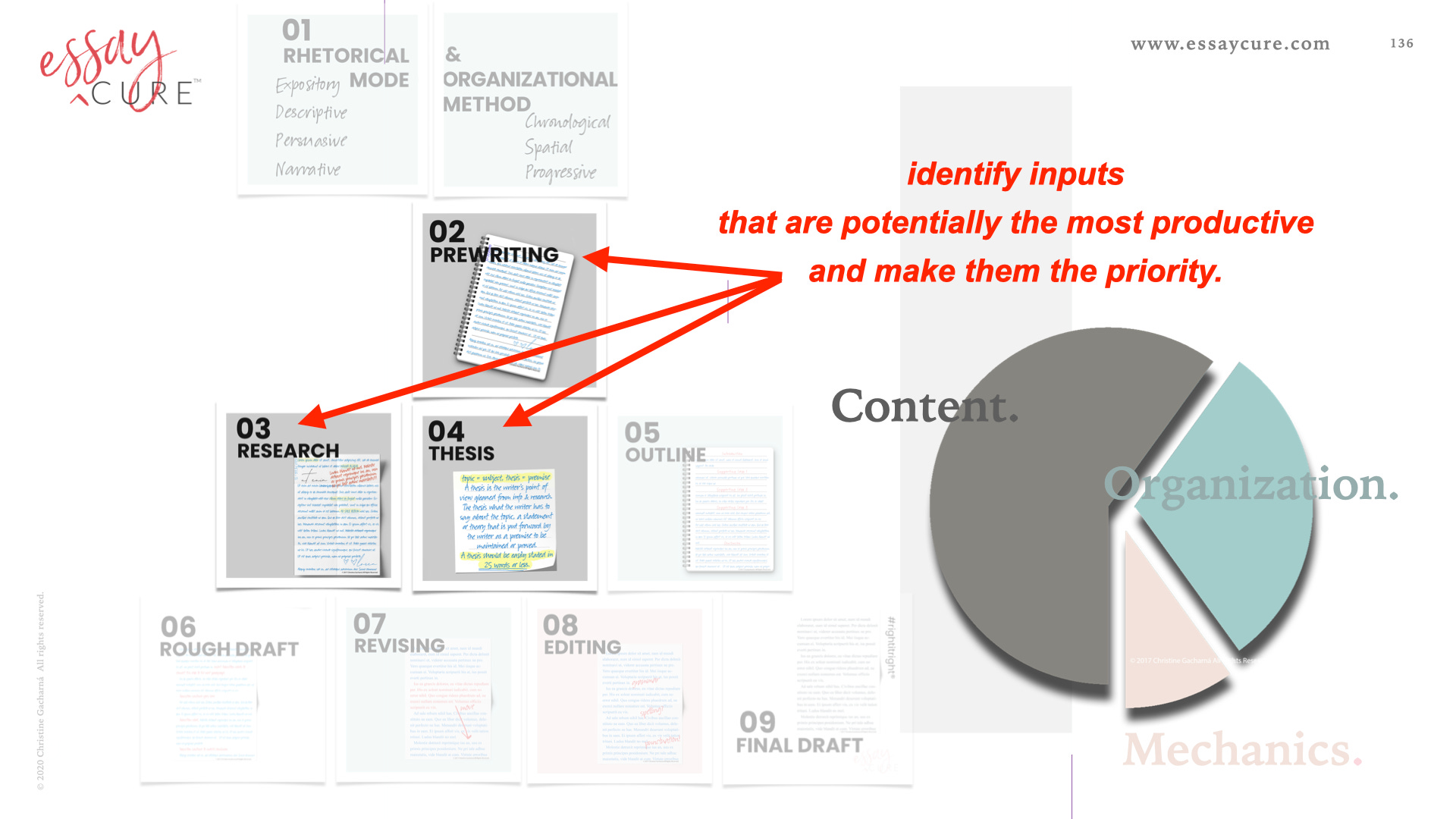
Prewriting, Research, Thesis. Following the steps in the writing process is the most productive way.
It may feel clunky at first. It might feel “weird” or “uncomfortable” or even “wrong” to fight against yourself and the muscle memory you’ve developed in high school in order to focus your efforts on the inputs that actually yield results. Do it anyway.
50% of your time should be spent on Pre-Writing ( we use Freewriting with college apps because those 15-minute daily brain-dump writing exercises are the fastest way to get words on the page).
Researching the schools to understand what makes them a genuinely good fit for you.
Crafting your Thesis—the clear, one-sentence answer to the essay prompt.
When you ask a mentor or counselor for feedback early on, break the habit of saying, “Will you edit this?”
Instead, ask: “How is my content?”
We already know you can write; you wouldn’t be here in front of me if you couldn’t. What matters more: what are you trying to say? Are you able to communicate that idea? It doesn’t matter how cleanly it’s punctuated if your reader wanders off the page.
Action Step: Your Timeline Starts Now
We want to kick off freewriting right around the July 4th holiday so that you are completely finished with your essays by Labor Day.
Open up a blank Google Doc. Don’t try to write an essay. Just pick a time you felt uncomfortable, an adjective that felt “wrong,” or a personal blind spot that blew up in your face, and start writing freely for 15 minutes. See what hits the page.


